Showing posts with label RomanBritain. Show all posts

Wednesday, June 5, 2024

#NathGeo: The Grosvenor Teacher Fellowship - Day 1

Today is a travel day. I was not expecting it to be fun, and so far, it’s worrisome. After watching a storm system rolling in all morning, I thought we’d beat it. So after already boarding my flight in Baton Rouge around 2, I was surprised to hear an announcement that they were deboarding us. The storm is coming through now - lots of wind, lightning, and rain. Typical summer storm here in Louisiana. 

The thunder reminds me of my mjölnir, or Thor’s hammer. I got interested in the symbol after watching the popular Netflix series THE LAST KINGDOM, about the 9th-century Danish invasion of what would one day become the unified kingdoms of England. The main character, born a Christian Saxon, gets captured and held as a slave by a Dane (or Viking). Loved by his captors, the Saxon boy, named Osbert, lives his teen and adult years as the Dane Uhtred. Throughout the series, Uhtred wears a mjölnir as a symbol of his belief in the Norse gods. He is known as a man who gets things done no matter what. Now, those things are not always good and righteous things - he serves as a mercenary for King Alfred the Great, but when something needs doing, they call Uhtred, his mjölnir hanging from his neck to protect him. The Norse mythological figure of Thor, god of thunder, uses his mjolnir to strike others down but also to offer blessings. Thus, the symbol seems particularly appropriate for such a conflicted character as Uhtred.


My favorite Greco-Roman god is Hephaestus, the maker, the craftsman, the metal forger, and hammer user. His mallet looks different from the mjolnir, and its purpose is different too. He hammers out beautiful and useful things for the other gods: thrones for the Olympians, jewelry for his wife Aphrodite, armor for the famous warrior Achilles, and even his own robots to assist him. His hammer is a creative tool. Years ago, when I first started teaching Roman Technology, I had to pull a nail out of a wooden form that I had for setting ancient concrete. One of my students saw me turn a hammer around and use its claw to pull out the nail. She was amazed at what she saw, "You're such a badass, Mrs. Roy!" I laughed at her ignorance of how a hammer works and at my newly-bestowed label. Shortly after this incident, I went to visit a dear old friend of mine who had just taken on a new job as the maker space coordinator at her local library. When I jokingly told her this story, she promptly walked across the room and pulled out a tiny purple 3-D printed hammer. Shortly after I received my special little hammer, I lost a job that I had had for 24 years. I connected these things in my mind and decided that the hammer was my new way of thinking through life. Just be creative and get things done. I moved onto a new job that allowed me to be creative and get things done.

Years later, I still love my hammer and wear it all the time. Whenever I have a special task to do, I wear my hammer. Whenever I have a presentation to give that I'm nervous about, I wear my hammer. Whenever I have a paper, article, or grant to write, I wear my hammer. With my new interest in the Danish world, I figured it made sense to get a mjolnir. This one is based on a famous one found in Denmark from the 9th century. It makes me think of all the cool things I'll be studying on this trip. I think of Uhtred getting it done. Here's my last picture waiting to board a flight in Atlanta to Edinburgh getting things done.


Sunday, June 2, 2024

#NathGeo: The Grosvenor Teacher Fellowship, Part 3 - The Countdown Begins

You read that right. My circumnavigation of the British Isles with National Geographic and Lindblad Expeditions departs in 6 days. I'm almost ready, but let's back up a bit in the story.

When I returned from the DC training at the National Geographic Society's headquarters, my students were very curious about my upcoming journey. I'm rarely out of school so when I take three days off in the middle of a school week, they need to know where I was and what I was doing. Simply telling them about it was not enough. They needed pictures, videos, and lots of details. I decided that I needed to get organized with how I shared my journey so I made a presentation (click the link to learn more) explaining everything about the Grosvenor Teacher Fellowship.

The students listened with rapt attention especially when I talked about my expedition ship, The National Geographic Explorer and the smaller zodiac boats that launch from it. This presentation came in very handy when I spoke to journalists about the fellowship. My local newspaper, The Baton Rouge Advocate, covered my story with a large article.
To maximize my students' interest, I decided to have them each do a small research project about a topic that would assist me on my expedition. I got this idea from one of the GTF alums, Karina New, whom I met at our DC training.

As I near the departure date for my expedition, I've been doing all kinds of preparation. I had to rent water-proof wellies (boots) for zodiac landings. I had to visit a doctor to talk about scopolamine patches and Dramamine for seasickness. I've never been seasick (even after an overnight ride on a commercial car ferry across the Mediterranean from Athens to Crete), but I've also never been on the North Sea. According to TikTok, the North Sea is trying to kill you. I've also bought some special gear like a phone lanyard so I don't accidentally drop my phone (camera) in the North Sea.

In addition, I've had to plan pre and post-expedition travel with my shipmate, Deb Frietag. We decided early that we would spend a few days traveling in Scotland before embarking on our expedition. We'll go to Glasgow to see the stunning Roman collection at the Hunterian Museum in Glasgow. My principal, Erin Howard, has already tasked me with getting "merch" with Glasgow on it since our school is named after the famous Scottish city. We'll spend one day taking a tour of the Highlands. After the expedition, I plan to spend another day in London visiting the British Museum to see Legion: Life in the Roman Army. This exhibition will end a few days after I see it so I feel so incredibly fortunate - it contains some of the most interesting Roman artefacts out there, borrowed from all over Europe. Most thrilling is the Vettweiss-Froitzheim dice tower that I've written entire Roman Technology class lessons on. I don't want to jinx it, but I truly can't wait to see this object with my own eyes.

I'll be sharing as much of my journey as I can. I hope you'll follow along!


Monday, May 20, 2024

#NathGeo: The Grosvenor Teacher Fellowship, Part 2 - Training at National Geographic Headquarters


When National Geographic called me to tell me they had named me a 2024 Grosvenor Teacher Fellow, they also invited me to visit National Geographic Headquarters in Washington, DC, for training. The experience was phenomenal!

Day 1

On a Wednesday morning early, I departed from Baton Rouge just in time to miss a huge storm that had canceled my school district's classes for the whole day. I felt lucky to get out safe and on time, but I felt even luckier when I got to DC and found my shipmate Deb Holcomb Freitag waiting for me. She is AMAZING. She teaches elementary and middle school social studies at a small school in Monticello, WI. Have you ever had that feeling that you knew someone in another life? That's how I feel about Deb. She and I just get along. And we both love museums, travel, and adventure.

After checking our bags into our hotel, we spent the afternoon at the National Portrait Gallery where we took in the American Presidents Gallery and many other famous people. I got to see the original painting of Juliette Gordon Low, the founder of Girl Scouts, in a pink silk dress by Edward Hughes.

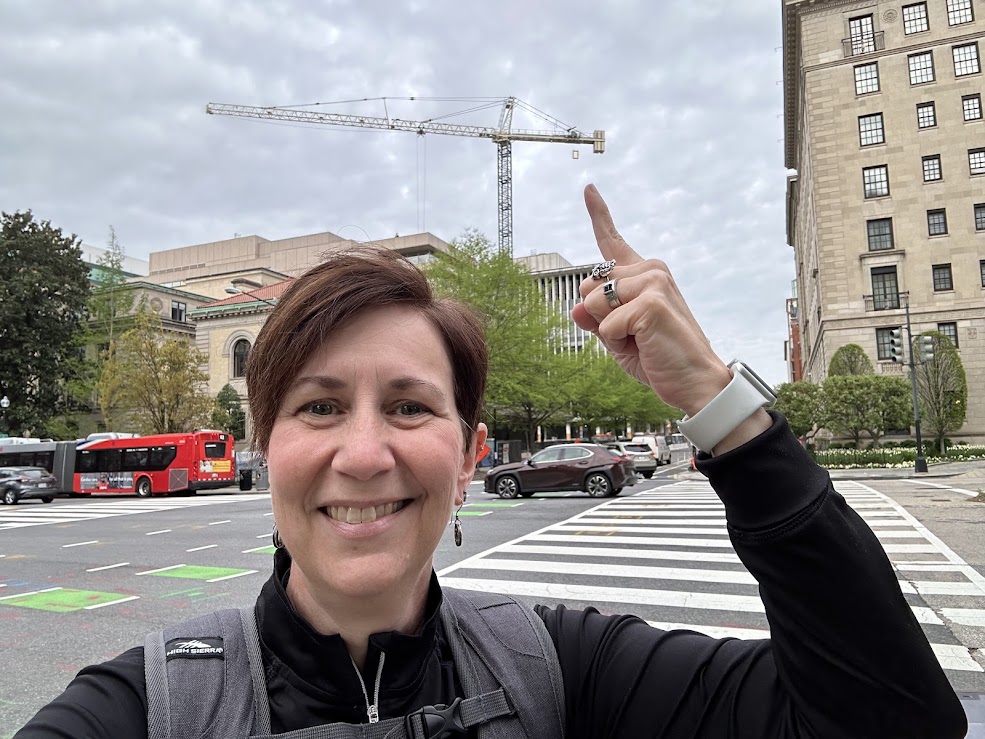
Can you see the yellow rectangle?
Later that evening, our program began at National Geographic Headquarters. Founded in 1888, the National Geographic Society purchased a small building that eventually morphed into a huge complex of multiple buildings in different styles. It was under construction, and with my eye for the mechanical, I immediately noticed that the giant crane towering above held a yellow rectangle dangling from it. And I took 18 million pictures of it.

At the entrance of the building is a beautiful bronze plaque inlaid in the floor, the official logo of the society. Just wandering around the complex was fascinating. But our destination that night was our opening reception. We heard from lots of people about the Grosvenor Teacher Fellowship and how it got started.
My foot on the bronze plaque!

Day 2

Deb and I were the first teachers there to take in the amazing building once again, get some breakfast, and gather our thoughts before we began an exciting day of learning. We got an overview of life aboard a ship, explored "explorer mindset" with the teacher Kip Hottman who talked about his journey to Antarctica, and learned about citizen science. We also discussed how to share our fellowship with media outlets. We ended the day by having dinner with some other teacher fellows. I was tired but invigorated by all I'd learned!


Day 3

If I had thought that Day 2 was crazy wonderful, Day 3 was 10 times as exciting. We started out hearing an exciting speaker, Alex Tait, the official geographer at National Geographic! He discussed the "geographic approach": observation > inquiry > data collection > analysis > visualization > communication > action. He stressed key geographic concepts to think of as we go our expeditions: 1. Place, 2. Pattern, 3. Layers, 4. Scale, and 5. Change through time. The biggest take-away for me from Alex's talk was the importance of STORY in geography. To illustrate this point, he shared storyteller Paul Salopek's "Out of Eden Walk."

Alex Tait, Geographer at NG
After meeting with some fellowship alums to discuss mapping and sharing our expeditions, we heard from Rosemary Martin, the director of educational grants at National Geographic. I took copious notes because I feel as though one day, I want to apply for one!

Last today was a photo boot camp with photographer Alex Daley-Clark. She talked about the five-photo story:
Image 1: Take an establishing shot that introduces the subject.
Image 2: Reveal some detail.
Image 3: Provide emotional context.
Image 4: Add more content.
Image 5: End the story.
Since one of our deliverables with the fellowship is to write a five-photo story, this workshop was extremely helpful. As a professional photographer, she also gave us the following tips:
1. Get CLOSE!
2. Look for the light including silhouettes.
3. Get high or low.
4. Look for patterns and reflections.
5. Fill the frame.
6. Use portrait mode.
7. Go wide - show the vastness of the location.
After this short lecture, Alex had us walk outside and actually take some pictures. Inspired by her tip to study reflections, I took the shot below of the National Geographic building with the sky reflected in its glass doors at the top of this post.

Day 4

In the morning sessions of this day, we got down to the nitty-gritty details about our individual expeditions. We met with our Lindblad experts, many of them either experienced photographers or naturalists. Deb and I met with Kevin Rattue whom we found out later would be our field staff mentor during our time on the expedition. We were thrilled about this news! Kevin has a geology background. Now retired, he spends about half of the year working as a naturalist for Lindblad. He gave us great tips about Edinburgh and many other places that we would be visiting. In the afternoon, we heard from GTF alums about their impact projects and work with students when they returned from the expeditions. They gave helpful advice on how to engage our students with an "explorer mindset."

Hanging around at NG
The last part of the training introduced the deliverables that we would be required to offer as fellows:

Year 1: The Expedition Experience
1. Storytelling for impact: Choose five photos from the expedition that narrate a powerful and compelling story about illuminating and protecting the wonder of our world. (Note to self - gonna be VERY challenging.)
2. Choose a platform to share the expedition experience with your community.
3. Give a short presentation aboard ship about your work as a fellow.

Year 2: Outreach after the Expedition
1. Plan an outreach event that highlights what you learned on the expedition.
2. Choose a leadership role within the fellowship either as a mentor to new fellows or as part of the education program at National Geographic.


Day 5

As I headed home, I was left with a sense of incredible promise. I can't wait to experience this journey with my students and school community. I took this picture during our photo boot camp, and I think it perfectly captures that feeling. The sky is the limit.

Thursday, May 16, 2024

#NathGeo: The Grosvenor Teacher Fellowship, Part I - How it Started

I'm sure I'm not alone when I share my love of National Geographic. I've watched their documentaries on PBS all my life. My favorite is In the Shadow of Vesuvius, about the people who died due to the eruption of the volcano in 79 CE and about the ones who still live near the deadly mountain today. It tells the story of physical anthropologist Sara Bisel who studied the bones of the residents of ancient Herculaneum. Unlike the residents of ancient Pompeii who had many hours to escape the eruption, Herculaneans died violently and quickly of thermal shock, a heat so hot that their brains probably evaporated. But I digress.

I love watching their documentaries. I can hear the theme song right now. And I still subscribe to the hard copy of the magazine that comes once a month with its yellow-bordered cover. It nearly always contains a story about classical archaeology. Founded in 1888, the National Geographic Society represents that spirit of adventure and discovery that so many teachers have.

That's why the Grosvenor Teacher Fellowship exists. Every year, National Geographic and Lindblad Expeditions selects about 35 teachers from all over North America to participate in the learning experience of a lifetime. National Geographic sends these teachers on expeditions with Lindblad, a company that specializes in exploring natural wonders all over the world: Alaska, Antarctica, Polynesia, Australia, Egypt, Iceland, the Galapagos, etc. Inspired by these expeditions, the teacher fellows write lessons and give presentations for National Geographic's educational arm. Through the process, students get to ride along for the excitement with their teachers. 

I learned of this opportunity through a 2018 fellow alum, Donnie Piercey. Also the 2021 Kentucky State Teacher of the Year, Donnie journeyed to Antarctica on his expedition and excitedly told all of his TOY cohort about his experience with the program: the penguins, the ice, and his polar plunge. I was intrigued and decided to apply.

The application process was rigorous. I had to write three essays about how I collaborated with community partners, how I designed projects for my students, and how I encouraged an explorer mindset. I also had to make a 2.5 minute video about myself. I decided to talk about how 4th-grade me had been denied the dream of becoming a paleontologist due to my mother telling me that "they had found all the dinosaurs already." You can see it here. (Apologies to my mom, but it's just a great story.)

I also had to choose dates that would work for me to take off 2 weeks in the next school year - these included the one month I had off this summer and other 1-week school vacations that would not incur the "wrath" of my principal. (Not really, she's totally supportive, but with a continued lack of substitute teachers in my school district, teachers being out near holidays is a hard situation for schools.) The tricky part about picking dates was that they didn't correspond to the destinations we chose. So...I hoped they would, but I didn't know.

I also had to list my 1st, 2nd, 3rd, and 4th choices of location to travel to. I chose an expedition called Ancient Isles: A Circumnavigation of the British Isles, Passage through Egypt, Exploring Alaska's Coastal Wilderness, and A Circumnavigation of Iceland. Since part of the program involves me writing lessons from my experience, I figured that I could connect each of those choices in some way to what I do in my classroom.

I turned everything in in December, and then the waiting started. I had read that those who were selected would receive a live phone call from a National Geographic or Lindblad employee sometime in February. February was almost over, and I had given up hope when on a random afternoon at 2:30 PM during dismissal time at my school, I got a phone call from New Jersey. The caller identified herself as someone calling from National Geographic to inform me that I had been chosen as a Grosvenor Teacher Fellow. As bells were ringing in the cavernous hallway and students were flooding by, I contained my excitement as she told me that I would be on the British Isles trip in early June and that I would need to go to Washington, DC, for a fellow workshop in April. I was speechless.

When I got home from work, I told my husband David first. "You suck," he said. "And congratulations, I'm so proud of you. But you really do suck." Cue the yellow rectangles.

I'll be sharing my experiences with the Grosvenor Teacher Fellowship on my blog, and on my GTF Website. Join me!

Sunday, August 13, 2023

Roman Britain for Latin Teachers

In 2019, I attended the ACL Summer Institute in New York City where I heard James Watson, a British Latin teacher, talk about his travels to Roman archaeological sites in his home country of England. I was intrigued because in the Latin textbook I use, called the Cambridge Latin Course, there is an entire story arc that takes place in ancient Britannia. I was struck with a curiosity to see the places James talked about and more. That talk started me on my own story arc.

In 1995, I was fortunate to receive a Fulbright Scholarship to travel to Greece where I participated in the summer session of the American School of Classical Studies at Athens for 6 weeks. In this program, students and teachers traveled to and learned about archaeological sites all over Greece and Crete. At the sites, we heard from actual archaeologists, usually the lead on that particular project or dig site. One of my most vivid memories from that trip is being told to go under the rope at the Parthenon where we climbed up a very tall ladder to touch the remaining parts of the marble frieze! In the school's famous Gennadius Library, I touched the journals of Heinrich Schliemann! In the agora, my class heard from the leading archaeologist, John Camp, while actually at the archaeological site! That's how awesome this program was in getting students close to the actual archaeology. I learned so much on that trip.

In 1996, the gods blessed me yet again when I earned a scholarship to participate in a comparable summer program in Italy at the American Academy in Rome. More memorable experiences and learning followed including walking around the streets of ancient Pompeii, experiencing the Pantheon on a quiet morning before the crowds arrived, and learning about Roman inscriptions. Another amazing experience!

Side note of importance: if you're interested in either of these programs, there are wonderful sources of funding out there. You can find a complete list of scholarships for attendance at the summer session of AAR right here and of ASCSA right here. I want to reiterate that these two programs added to my classical education enormously. I would not be the teacher I am today without these experiences. Thus, I was so terribly disappointed to learn that there was not a similar program, regularly offered, in England to assist classics teachers in exploring the significant Roman sites there. To be fair, the Vergilian Society will be offering just such a tour for teachers in the summer of 2024, but this program is not an annual one.

As you can probably guess, I decided to design my own tour of the Roman archaeological sites in the UK. I enjoyed immensely the process of researching the sites and then planning the itinerary, but before that, I had to secure funding. If you're doing the same thing, you'll want to look into three organizations that offer funding for a teacher who is "designing your own" travel study experience:

The Society for Classical Studies offers numerous options. The National Latin Exam offers the Christine Sleeper Educational Travel Award. I was fortunate enough to get scholarships from both organizations. That funding paid for most of my trip! Extra money acquired through speaking engagements and writing assignments for the past few years related to my Teacher of the Year (Louisiana 2021) status allowed my husband to accompany me as my driver. (Trust me - I needed one.)

Through research, reading, and listening to the English Heritage Podcast, I designed this itinerary starting in London, heading east, and then making a big circle around all of Britain. As far as I can tell, it worked out great. I missed a few sites that I will get back to later, but for the most part, I saw everything I hoped to see. You can see my actual itinerary here.

Because I'm a nerd, and because I like to help, I've created a Website called Roman Britain for Latin Teachers. This project gave me an opportunity to review my pictures, read books I bought, and relive the adventure - all things necessary to set the learning in my own mind. On this site, you'll find all kinds of information about how to plan your own tour and prepare for it, how to incorporate Britannia into your Cambridge Latin Course lessons, and how to use my museum and site pictures in your classroom. I hope it helps you! Now get yourself to Britain!


Roman Technology: Growing Tiberius' Cucumbers

Three years ago, my Roman Technology class started a small container garden to plant herbs for our food unit. I wanted the students to be ab...