Showing posts with label STEMChallenge. Show all posts

Tuesday, May 19, 2026

#NathGeo: Beyond the Yellow Rectangle

At the beginning of May, I arrived at a milestone: the end of my 2-year Grosvenor Teacher Fellowship with National Geographic and Lindblad Expeditions. Named after Gil Grosvenor, the legendary president of the National Geographic Society and longtime editor of its magazine, this fellowship helps teachers to gain an explorer mindset through an expedition and outreach work with their students. Throughout his life, he had a love for teaching. As he traveled the country for speaking engagements, he often stayed an extra day and served as a substitute teacher at local schools. He did this very thing in the mid-90s here in my town of Baton Rouge, LA: after talking to the Rotary Club about his time in NG, he spent the next day teaching geography lessons to teenagers at McKinley Middle!

For his 75th birthday, the founder of Lindblad Expeditions offered free berths on its ships to teachers, and the fellowship was born. You can listen to Grosvenor talk about his experience in this podcast. He tells his life story in his book, A Man of the World: My Life at National Geographic.

My fellowship started in April of 2024 when I trained at National Geographic Headquarters in Washington, DC, one of the loveliest professional development experiences of my entire teaching career - the educational sessions, the people, the location, just the whole thing. My expedition, a circumnavigation of the British Isles, starting in Edinburgh, Scotland, traveled up to the Orkney and Shetland islands, continued along the western coast of Ireland, stopped at the magical Isles of Scilly, and ended in London. Paired with Deb Freitag, a social studies teacher from Wisconsin, I left the expedition with such grand ideas about how to implement what I had learned.


My students and I accomplished A LOT. The Roman Shoe Project gained steam through this fellowship. We did a book study, field trips to archaeological sites and national parks, and hosted two archaeology-themed outreach events led by the students. The final requirement of the fellowship was a take-action project to make the world a better place. I hadn't really thought much about what this project would entail, but it happened organically.

This past year, I taught a class called Hands-On History for 8th graders who had already taken my Myth Makers and Roman Technology classes. We tended a garden for the whole year, we did an oral history project about a long-gone sheep farm near our school, we learned about ancient atlatls, dyes, shipwrecks, and all things archaeology. Most impactful, though, we partnered with the Pontchartrain Conservancy as we participated in two of their programs: Consider Litter and FLOW (Facilitating Learning in Our Watershed). The students and I learned so, so much about the water that surrounds us in Louisiana. To be honest, I had no business taking on these projects because I'm not a science teacher. However, the Pontchartrain Conservancy assured me that they did not care - they would train me to do the things they wanted the kids to learn. Me? Doing water quality testing? It happened! And it was awesome. Read about it in this blog post.

This environmental focus in Hands-On History class really got me thinking about how I could bring the environment to my other classes. Then, a researcher friend of mine at LSU reached out to me to see if I'd be interested in participating in a program funded by the Environmental Protection Act, called Plastics on Parade, about plastic pollution caused by Mardi Gras parades in New Orleans. Since Mardi Gras has deep connections to Greek mythology, I seized upon the idea to connect this environmental unit to my Myth Makers class. It worked out so well, that I reported on it as my capstone project for our ending presentation session with the fellowship.

The project was called Poseidon's Promise. You can read about the whole concept behind the project in this blog post. The presentation was difficult in that we were only allowed to choose 3 photos to express our ideas in 3 minutes. HARD! You can see my final presentation and talking points in this link. The most amazing thing about our presentation night was the fact that Gil Grosvenor HIMSELF was in attendance with his daughter. He had turned 95 years old the day before, and he wanted to express to us how awesome teachers are. We sang him the "happy birthday" song, and he watched us give our presentations. I captured this video of him wishing us well. It was a moving end to my fellowship.


This summer, I'll be in DC attending the triennial National Council Session and Convention of Girl Scouts of the USA. While there, I hope to visit the new National Geographic Museum of Exploration, which was under construction during my training time. Even though my fellowship is officially ending, the explorer mindset that I've built will continue. It truly changed my perspective on how to incorporate the natural world into my classes. Next year, my Roman Technology students will be growing cucumbers and lettuce to incorporate into our lessons on ancient food. We'll also be building a Roman boat (fingers crossed on grants coming through) that we can launch in a nearby lake - and yes, we'll be testing water quality in that lake.

All thanks to Gil Grosvenor! Thank you, sir.

Tuesday, February 17, 2026

Myth Makers: Mythological Mardi Gras and Poseidon's Promise

This is finally the year!! I'm writing a Myth Makers unit on the mythological origins and imagery of Mardi Gras, plus incorporating an environmentally sustainable STEM challenge. (Not from Louisiana and need to brush up on the basics of Mardi Gras' origins and traditions? Read this National Geographic article.)

When I married a man from New Orleans, I became a frequent Mardi Gras reveler, enjoying many, many parades every season for the past 20 years or so. And I noticed immediately the plethora of classical connections, from the names of the krewes (Orpheus and Bacchus to name just two) to the float themes and decorations. Mardi Gras has deep roots in classical culture, not always the brightest aspects of it, but I knew that my Myth Makers would enjoy making some connections.


I also noticed that Mardi Gras is MESSY. The sheer volume of plastic used in throws such as cups, bags, trinkets, and of course, beads, was astounding to me. In fact, during a cleanup of the gutters in 2018 after a flood, the city of New Orleans cleaned out 46.5 TONS of beads along a short stretch of street! I've witnessed it myself - after a parade finishes, the streets are littered with plastic everything. Street sweepers come through and rid the pavement of tripping hazards for marching band musicians, but where does all that plastic go?


When I found out about a program called Plastics on Parade: Cultivating Responsible Parade Culture in Louisiana, I immediately started thinking about how I could get my students involved. Funded by a grant from the Environmental Protection Agency through LSU's Dr. Jennifer Cook (a Girl Scout sister of mine), the program teaches kids about the environmental impacts of Mardi Gras and challenges the students to consider more sustainable solutions.

What we've done so far:
1. Investigate the names of Mardi Gras krewes for classical connections: my Myth Makers (all 66 of them) had to choose a classically-named krewe to research and discuss with a friend. The link above contains my list of them, but I know I missed some already. Since I'm hoping to make this an on-going project, I'll add as I learn of more or new ones.

2. Learn about what Mardi Gras plastic does to the environment: In this presentation, the students learned about sustainable initiatives such as Verdi Gras and companies that market and sell sustainable throws. I highly recommend their clickable presentation called "The Path of a Bead." It's full of jaw-dropping facts such as...did you know that Mardi Gras beads are made from plastic pellets called "nurdles," many of which are manufactured right here in Louisiana in one of the most carcinogenic processes in the world? Those nurdles are then shipped to China where companies produce cheap beads that are then shipped BACK to Louisiana for Mardi Gras.

3. Learn about LSU's Dr. Naohiro Kato and his team: A team of biochemical engineers at LSU has produced algae that can be dried and 3D printed into Mardi Gras beads. Some designs even have seeds built into them!


4. Discover the history and iconography of doubloons: These cheap aluminium coins are a collectible Mardi Gras staple, and they are full of classical myth connections. The students learned basic coin terminology, explored doubloon examples from many different krewes, and then sketched them. Side note: I had a ton of fun researching the history of doubloons - these are my favorite Mardi Gras delights!


5. STEM Challenge: The students have been tasked with developing three sustainable cardboard throws: a doubloon, a beaded necklace, and a signature throw, depending on the krewe they've chosen to design for. They are working in teams of three so that they each work on ONE item, but those throws have to match in theme and look. 

Thanks to some grant money for this work, I was able to purchase some ChompSaws for easy and safe cardboard cutting, and the students are loving them so far. I can't wait to see what they create!


When we're done with the challenge, we've decided to write letters to their krewes to suggest more sustainable throw alternatives. As I've told them, it will be up to the next generation of students/THEM to change how we run Mardi Gras. I KNOW they can do it!

Updates:

You can see the doubloons, necklaces, and signature throws that the students created in this Google Photos folder. They are absolutely amazing. Yes, some are a bit rough, but they did only have so much time. One of the students came up with the idea that school art programs could help produce throws for the parades. Indeed, some already paint coconuts for Zulu. Why not all krewes? A great point!

We sent about 50 letters to krewe royalty politely educating them about the plastic pollution cycle and requesting more sustainable practices in the future. We haven't received any replies, but I hope we've made an impact in some way.

I used this project as the final capstone presentation for my Grosvenor Teacher Fellowship with National Geographic and Lindblad Expeditions. Take a look at my slides and talking points here

Monday, January 26, 2026

Myth Makers: All Hail the Queens

My Myth Makers have been hard at work this year getting ready for their Pegasus National Mythology Exam. Part of that prep work, of course, is reading and listening to all the stories, taking notes, and practicing their knowledge. But the other, FUNNER, part of the Myth Makers class is MAKING. This year, I've developed two new STEAM challenges that the students really enjoyed so I thought I'd share them here.


THE INCREDIBLE CROWN PROJECT: A few years ago, I wrote a STEM challenge in which the students had to design and build their own scepter to represent their personal god/dess power. You can read more about that project in this blog post. The kids loved it, but it took up a LOT of space in my classroom to store the projects. Some of these things were as tall as the students with multiple and moving parts. So this year, I thought I'd scale down the idea while still sticking to the theme of royalty and focusing specifically on Hera, queen of the gods, often demonized as the "jealous" wife of Zeus when in fact, she's more of a victim of his bad behavior. The project asks students to create a special crown for Hera, symbolizing her status. Because she was too busy to join us for a fitting, Hera had designated ME as her model. THAT detail really got some eyerolls (as I expected), but they totally used me as their mannequin. LOL

You can see the guidelines in this document. I started by demonstrating to the students how to fold a simple paper crown - this video explains it well - that would serve as a strong base for their designs, and they practiced using scrap paper before they began their actual project. It's super important to always start STEAM challenges by instructing the students in some basic skills, such as how to fold paper effectively. I know it sounds crazy, but some kids don't know how to make really flat, crisp folds. I'll never forget this incident from a couple of years ago: a new science teacher came over to my classroom to discuss an idea he had. He was going to use paper airplanes in his lesson, and I stopped him immediately, asking, "Are you sure the kids know how to make those?" He thought it was a ridiculous question, but he ended up having to rethink his lesson on the "fly" when, indeed, the majority of his students knew nothing about paper airplanes. It's a good reminder that, in today's world, teachers should not assume that students have the same experiences with making and building that our generation did. Years ago, during a lesson with arch building block kits, an 11-year-old told me he had never used building blocks before. Making is not the norm anymore!


The students worked in partnerships to make their crown designs, and some of the finished designs blew me away with their artistry!! These makers literally had paper, tape, scissors, and markers to make these things, and they totally delivered amazing works of art. After time was up (some teams worked until the very last second just like in Project Runway), we cleared a runway through the classroom, and I modeled each crown. One student asked if she could be the "commentator," and it was hilarious! As I worked that runway, the students wrote reflections on their work and the work of others (see page 2 of the linked document above). After it was over, I displayed the crowns easily by flattening them and stapling them to a bulletin board in my classroom (a plus if you have observers who like to see students' work). Can I just say how marvelous some of these were?! One team actually created paper peacock feathers that hung down from the back of the crown and shaped a paper bird on the front. It was stunning! Hera would definitely have wanted to wear these.


THE NUPTIAL NECKLACE PROJECT: The kids liked making crowns so much that I decided to keep going with the theme of adornment. Using Hephaestus as our maker model again, I challenged the students to make a necklace for Aphrodite. In the story of the mismatched love of Hephaestus and Aphrodite, he crafts many beautiful items for her, including a golden girdle (or belt) that makes her irresistable. Before the challenge, I taught the students two methods for designing their necklaces: paper chains and paper beads. They had lots of supplies to choose from, including glossy magazines and colorful papers. Some chose the simpler paper chain method, but others didn't shy away from making paper beads. These are beads made from long, triangular strips of paper that are rolled up on a stylus and glued to close them. There are so, so many tutorials online and so many materials that can be used to created these. But once I taught the students the basic methodology, they were off and running, taking the method into whatever direction they wanted to. Using the engineering design process as we do with every project, the students worked in teams of three and began with a sketch. After sketching their designs, they got to work on making and creating.


As always, they completely "ATE" this project (as they say). One team went deep into the relationship of Hephaestus and Aphrodite. They made shackle bracelets because they felt as though he was trying to restrain her from being with Ares. 


I modeled the necklaces in another fashion show, and they wrote their reflections (all linked in the document above). They learned a lot about Hephaestus, making, collaborating with partners, and had fun doing it all.

When I design maker challenges, I'm reminded of Dale Dougherty’s writings (he sums them up in this TED Talk). In case you don't know, he's considered by some to be the founder of the Maker Movement. “Makers are playful, resourceful, and experimental. They not only help themselves, but they help others. Makers do well because they can adapt to change as self-directed learners, but they are also agents of change. In this movement, makers are setting their agendas and asking others to join them.” I encourage my students to be MAKERS on a small scale because I'm hoping to inspire them to do BIGGER things later in life. They need practice!


Friday, June 6, 2025

The Year in Roman Technology: "Unhinged" Secret Messages

People always ask, "What do teachers do during the summer?" Some actually work. In fact, I normally work at my school's summer camp. This year, I decided to take a breath and sit down. It's been almost a week now, and I'm about to go crazy. LOL. Kinda. I've always been someone who can't sit still mentally...well, or physically. I'm researching two really cool projects for next year so I thought I'd share what I'm learning, as I like to do.

ANCIENT CRYPTOGRAPHY!!!! A few years ago, one of my Latin/Science Olympiad students approached me to tell me about his cryptography club at the library. Intriguing. He told me that he had learned about the Caesar Cipher, an ancient mechanism whereby Julius Caesar, the 1st century Roman general, encrypted his messages during wartime. I had never heard of it! Of course, he told me everything he knew, and I furiously wrote it down...thinking, "OHHHH, this will be a GREAT RoTech unit!" I immediately thought of that time in DE BELLO GALLICO where Caesar sends a secret message to one of his men using a spear. I ALWAYS wanted to know how he did it.

Then, during spring break, by divine intervention, I'm sure, I ran across an online webinar about the Roman dodecahedron. Since we had talked about this little mystery device in my RoTech class, I decided to click the link. It led me to a tour company that sponsors professionals in many different fields to talk about topics related to their tour locations. It was here that I discovered a series of lectures on ancient Greek and Roman cryptography! These lectures, given by Dr. Martine Diepenbroek, discussed all kinds of ancient encryption. She talked about ancient encryption techniques, including the Spartan scytale which involved wrapping a message around a stick or spear. I immediately bought her book, The Spartan Scytale and Developments in Ancient and Modern Cryptography. She also mentioned a Greek author I had never heard of: Aineias the Tactician whose book on war tactics includes a whole chapter about encryption. I ordered that too! LOL

I've started reading these two works, and I'm having an absolute blast. Aineias, a 4th-century BCE Greek writer, wrote a work called How to Survive Under Siege. Lots of info here, but the most interesting chapter is all about hiding messages so that your enemy can't read them. If you're on TikTok, you've probably seen that trend where someone says, "Give me your most UNHINGED examples of blah, blah." Examples include nurses asking for ways to assist with difficult patients to teachers asking for ways to quiet a classroom. Well, this Aineias guy is something else!! Reading his encryption techniques is basically that TikTok trend: "Give me your most unhinged ways to hide a message that will evade the enemy!" Hold my beer: "Shave a slave's head, tattoo your message on his scalp, and then give him time to regrow his hair before sending him off." Like, WHUT??! "Scratch your message into a thin piece of lead, secretly slip it into the leather layers of a shoe heel, and then send off the shoe wearer. Unbeknownst to the shoe wearer while he's sleeping, the receiver of the message will retrieve the shoe, find the message, scratch his answer, and sew it back into the shoe."

Diepenbroek's work has been so informative as well. For example, I learned the difference between STEGANOGRAPHY and CRYPTOGRAPHY. In case you didn't know, steganography is "the practice of hiding a message within another message, an image, or an object, without giving the idea that a secret message is hidden in it." It's a broad term for LOTS of different types of messages, similar to the ones above. She also has a comprehensive list of ancient authors who use or talk about cryptography in their works.

I got so excited reading about these that I decided to try out the Caesar Cipher as a quick end-of-year activity with my students. I led them in creating a Caesar Cipher wheel, linked here. And then, they enjoyed decoding a few current brain-rot words that made them cringe like "THE RIZZLER". Their faces fell in true bitterness when they decoded BOOGER TOUCH - our favorite little game to play on Fridays. 


Diepenbroek's book mainly discusses the Spartan scytale, a method of encrypting messages using a particular size of stick (trust me, the lesson on this one is gonna be SOOO fun) and how it gave birth to the modern cryptography movement. I'm excited to read it because in the modern STEM world, teaching kids to code at all ages is the rage. I'm excited to connect this stuff to the ancient world of Greece and Rome!

I'm particularly interested in ancient cryptography right now because I'm so fortunate to be the recipient of the 2025 Classical Association of the Middle West and South's Benario Travel Award, a fellowship for travels to classical lands. Herbert and Janice Benario, the award's namesakes, are former Latin teachers from Georgia, but before she became a Latin teacher, Janice served as a code breaker for the US Navy during WWII! Check out interviews done with her here as part of the oral history project done by the National WWII Museum (in my home state of Louisiana.) What a connection!


I chose to use my fellowship to take an archaeological tour of ancient Provence (southern France). I've always wanted to see the Pont du Gard, a super famous Roman aqueduct and UNESCO World Heritage Site. But before I make my way south, I've decided to see the WWII sites on the Normandy Beaches, the Bayeux Tapestry, and Mont St. Michel. I can't wait to learn all I can about the work that Janice Benario did and many other codebreakers like her. Recently, I read Bruchac's Code Talker: A Novel about the Navajo Marines of World War Two. I also need to get hold of Kahn's Codebreakers: The Comprehensive History of Secret Communication from Ancient Times to the Internet. More secret messages to come!

Wednesday, February 19, 2025

The Roman Shoe Project: A Guest Speaker from Left Field

At the beginning of the school year, our school district asked all teachers and students to take a RIASEC assessment. I had never heard of RIASEC before. In case you haven't either, it's a personality test based on the work of mid-century psychologist John Holland who believed that people are happiest when they have jobs that align with their personalities. I was none too surprised that I tested as a SOCIAL person, one who enjoys helping others and teaching. If you want to see the other categories and their matched careers, you can look here. Because Louisiana graduation rates are some of the lowest in our country, our district likes its middle schools to introduce careers to our students whenever we can. I must admit, I didn't seriously think about what I wanted to be until I was in college. I wish I had met an archaeologist sooner. It may have changed my mind...

That's the idea behind my principal's push to get professionals in our classrooms whenever we can - get kids thinking. So when I asked my Facebook friends who work with leather if they would consider to talking to my students, I got an unexpected surprise. My former colleague's husband runs a wonderful business called "The Glove Doctor." Chad Chenevert repairs leather baseball and softball gloves! And he was SO gracious to visit with my students to talk about his work.

Did you know that leather gloves can last for the entire career of a player? Did you know that they can cost 100s of dollars? Here's one you probably knew, but I'm just so out of this loop that I didn't know. Gloves are specialized based on the position of the player! It makes total sense, but I really didn't know that. You can probably tell that I love to learn about pretty much everything. In addition to all this cool information, Chad presented to the kids on the history of baseball gloves and even talked about leather tanning too. Then, he told the story of how he got into fixing gloves for his son's teammates and eventually for LSU players and even some professionals. 

After the kids asked him a million questions, Chad showed the kids some of the tools he uses to repair gloves and condition new ones. They loved this wooden mallet, used to break in new gloves. He also let them look at the different colored leather cord available for stringing gloves. Some players like to get their gloves strung in the colors of their school.

Overall, it was fascinating to see that the tools Chad uses to work with leather are nearly the same as the ones used by ancient shoemakers: awls, knives, needles. Chad's wife Michelle, a tech guru at my old school, made the above image for us using AI. The kids got the biggest kick out of it, but I thought it was perfect - even though the Romans would not have used baseball gloves, it's a great reminder of the similarities between ancient and modern leatherworking.

Asking working adults to spend half a day away from their work to talk to my students is hard for me. I honestly hate to do it because I know that everyone is busy, but I have never had an adult say that they didn't enjoy sharing what they do with the students. And the kids had a blast learning about this unique work. 

Thanks a million to Chad for being so generous with his time and knowledge. If you need a glove doctor, he should be your first stop.

Monday, February 17, 2025

The Roman Shoe Project: Baby Steps with BULLAE

With all the fascinating information out there about ancient Roman leather shoes, I knew that I would have plenty of lessons to share with my students. But, we needed to start small so the kids could learn how to work with leather and its traditional tools.

Our first project was making our own Roman bullae. These ceremonial necklaces were given to children at age 9. The archaeological record gives us numerous ones made of gold and goldplate, but a couple of Roman authors refer to ones made of leather. You can see our notes on these (and some pictures in this slide deck). Female students were happy to learn of the existence of the lunula, given to girls with the same purpose in mind.

My first step was to create a pattern for both shapes so that students could choose either one (you can see that pattern here). Although ancient children would not have had a choice, ancient children would not have been making their own leather bulla either so I figured why not? I had several students choose the opposite shape because they simply liked the way the shape looked. They also needed practice with tracing a pattern since most students had no sewing experience. For this project, we used thin-tempered (pliable) chrome-tanned scrap leather that is available from craft stores for very cheap (this bag is only $10).

From the get-go, I knew that I would not be teaching my students about leather-working knives because they are a bit too sharp for my liking. I don't normally shy away from sharp tools (my students are learning how to use awls, for example), but knives seemed a step too far. Thus, we've been practicing with scissors. And if you're using scissors in your classes, I hope you're training your students how to walk safely and slowly when retrieving these for use. Before we began this unit on leatherworking, I had each of my students take notes on the different tools and how to use them safely and then commit on paper with a safety pledge. Advice from someone who uses tools often in class - never skimp on safety.

After tracing the patterns onto leather, the students got to work on cutting them out. The next step was to learn how to use leather punches and awls to make holes where the bullae and lunulae would be sewn up around the edges. They folded the pattern over so that their holes would be in the same spots on both sides of the leather. Did they do this properly? Not in all cases, but this was part of the reason why I wanted them to practice on a smaller project first...before we use expensive leather for our shoes.

Next, the students had to sew their leather necklaces shut. Did students need lots of help threading needles and using thread? Of course. Did that stop me from doing this project? Nope. Some projects test my patience and that of my students, but is that a deciding factor? Nope. Students (and teachers) need to practice patience and resilience.

Last, the students chose special objects to put in their necklace pouches. One student chose a silver dollar his dad had given him for good luck. Another chose a crystal he had been keeping on his desk at home. I wish we had more evidence about what the Romans put in theirs.

All in all, this project was a good one to introduce the students to simple leather working tools and techniques. It also yielded wearable items! I see my students wearing them all the time as if they are super proud of them. As they should be.


Note to teachers looking to replicate this project, but without the tools or actual leather: former Latin teacher Ginny Lindzey has a great lesson on it posted on her Website in which she uses foil to recreate the bullae.

Sunday, February 16, 2025

The Roman Shoe Project: Stepping into Hands-on History

I've been MIA from blogging for the past couple of months because this project has demanded my full attention. We have really been busy. Let me start from the beginning!

During the pandemic, I became a huge fan of watching online lectures by archaeologists. The Archaeological Institute of America offered (and still does) monthly lectures for free, and it was at one of these that I learned of the leather collection at the site of Vindolanda on Hadrian's Wall in northern England. Dr. Elizabeth M. Greene spoke about the Roman shoes that she has excavated through years of work there. She explained that the soil of Vindolanda is particularly anaerobic and preserves leather very well. Archaeologists have found hundreds of shoes at this site, once a fort and town on the edge of the empire. Some of the shoes, found in a waste area of the town, had been discarded by those moving on to other places. Some may have been lost. Some were found with their twin. I was intrigued by these shoes and the stories they might tell us.

Shockingly, the shoes look almost modern. It's pretty easy to see how they were designed and tooled. I immediately began thinking about how I could incorporate ancient leathercraft into my Roman Technology classes. In years past, the students have made their own leather bullae, or childhood protective amulets. They used small leather punches to make holes in scrap leather I purchased, and then they sewed the little pouches shut with twine, enclosing a special tiny object for themselves before putting on their necklaces. "Could we make shoes too?" I started to wonder.

In the summer of 2023, I was fortunate to receive a travel scholarship from the National Latin Exam. I designed my own trip to Roman Britain, and of course, Vindolanda was on my list. I wanted to see its famed shoes myself! You can peruse my collection of leather shoe photographs here.

When I arrived for my visit to the archaeological site, I was touched to see this sign at the entrance. It REALLY got me thinking about studying shoes. The old adage goes, "Before you criticize a man, walk a mile in his shoes." My students can learn deeply about the daily lives of the Romans we study by recreating their shoes.

Most information about the classical world comes from literature written by wealthy, upper-class male citizens. They had the time and resources to write about their lives. But what about the others? Women, children, enslaved people, craftspeople? I want my students to learn about them too. Hands-on history projects like creating leather shoes allow students a window into the daily lives of people whose voices aren't often heard in literature.

So, can we do it? The students will be learning about the sources of leather in the ancient world, about the tanning process, about the craftspeople who made shoes, and about the people who wore them. We'll then design and craft our own Roman-style leather sandals or boots before experimenting with their use in our daily lives. We'll be making "footsteps into the past."

Thursday, October 3, 2024

This Year in Roman Technology: Catapults

I never really thought much about ancient Roman catapults, to be honest. Even with 7 years of college, two classics degrees, and archaeological study abroad in Italy and Greece. Catapults were never on my radar. That all changed when, on Friday, May 5, 2000 (I remember the exact date), I saw the Ridley Scott movie Gladiator. And if you've seen it too, you already know what I'm going to say. That first scene, right? OMG. If you haven't seen it, stop what you're doing and go watch it right now. It depicts the highly-organized, brute strength of the Roman legions attacking the "German horde" painted as an unsophisticated mass of dirty barbarians. A bit cliched, yes, but the weapons were unlike anything I had ever seen...or heard: the thump of the exploding pots of burning oil hurled by the giant onagers, the whiz of the huge ballista arrows, and the whoosh of the fiery arrows shot by the archers. The whole spectacle made me re-think the experience of war. Who considers the SOUND of war? Maybe I'm in the minority amongst Latin teachers, but I loved the movie, warts and all. 

Many years later, I read Vitruvius' description of a Roman scorpion in Book X of his De Architectura. I was fascinated, and cursory searches on the internet found numerous replicas based on his writing, the most descriptive being this one by Wade Hutchison and Steve Godfrey. As I was contemplating projects for the first iteration of my Roman Technology class, I very much wanted to work on catapults, but unlike Hutchison and Godfrey, I had none of the wood-working skills that are absolutely essential for such a project. I turned my attention elsewhere that year and forgot about catapults.

A year later, I was working in EBR Schools at the #BestMiddleSchoolInTheParish teaching Roman Technology, and I was selected for a STEM fellowship. Fellows got mentorship with a STEM teacher who helped us to develop projects for our programs. I was so fortunate to meet Heather Howle, a STEM teacher who had written her own curriculum and valued the idea of integrating history and engineering. Through her guidance as my STEM mentor, I learned that STEM teachers use catapults frequently to teach force and motion in physics. The aerospace industry uses them to launch and land fighter jets off aircraft carriers through a system called CATOBAR, an acronym for "catapult-assisted take-off barrier arrested recovery." (Watch here for an explanation of how this system works.) Thus, catapults are particularly relevant in today's real world, not just as a tool for learning.

As I learned more about catapults, I picked up some great ideas about how to teach them. One of the best catapult teaching units I've seen is by Vivify STEM, a two-woman team of Texas-based aerospace engineers turned educators. Here's a free one by Engineering with Paper (all you need is paper, scissors, and tape!) With these plans, I particularly liked that I didn't have to know wood-working to create devices that could be built by students and tested like ancient Roman ones. Unlike the real ones, these are safe to shoot with projectiles like q-tips, ping-pong balls, pencil erasers, and cotton balls. I always teach them in September because they teach students the basic concepts of the engineering design process. If kids have not taken a STEM class and/or were never encouraged to build with blocks as youngsters, they sometimes struggle with designing and building their own devices. Catapults are a low-stakes way to learn. 

This year's students are no exception. They have LOVED learning about catapults. We began the unit with an overview of the Roman war machine. Of course, I add lots of history and textual evidence. We read excerpts from Vitruvius and Josephus, for example. The students learned about different siege weapons of the Romans including onagers, ballistas, scorpions, siege towers, battering rams, naval rams, etc. This past month, I got stuck in a research rut learning about the Balearic slingers and the bullets of lead and clay that they used. Fascinating stuff, and of course, I'm trying to come up with a safe way to teach them about slinging!

During our STEM labs, we learned how to build two models (an ONAGER and a SCORPION) with my assistance, and then they tested them with different projectiles for accuracy and then for distance. The students practiced using tape measures, recorded data, and then reviewed how to figure averages. (Math teachers love me around this time of year.) Then, we took it to the next level, and they designed their own catapults to fire and test.

If you're interested in learning more, see my catapult lesson here. Let the fun and learning begin!

Sunday, November 26, 2023

Myth Makers - Make Your Own Scepter Project!

Alright, myth lovers, have you ever wondered about the thyrsus of Dionysus? His staff, or wand, was always my favorite of the Olympian gods. Ever since I've taught Myth Makers, the mythology class I've developed around maker culture, students have asked me about the thyrsus. "Why does it have a pinecone on top of it? Why do the Maenads (the followers of Dionysus) also carry it?" If you want to know the answers to these questions and more, you should read this article. It explains that the pinecone is really an artichoke. As interesting as this is, that's not what this blog post is about, but I couldn't help but mention it! It's too nerdy not to.

Can we talk about all the cool scepters that the Olympian gods hold? I like to talk about Dionysus because he's my favorite, but the students love Poseidon's trident, Hermes' caduceus, and don't forget the bident of Hades. Who doesn't love a scepter to show off power?

These scepters also represent the gods in a visual way. As the students begin to learn about the Olympians, these symbols help them remember the gods more easily.

I use this concept to spark a maker challenge: the make-your-own scepter challenge! Students begin by learning some basic paper folding techniques. Learning to fold paper skillfully can be tricky for some students so trust me: start simple.

I leveled up my myth-making game when I discovered Engineering with Paper. Godwyn Morris founded this small after-school maker lab in New York City for kids to learn making (you can watch a short video about the concept here.) I highly recommend their free projects like catapults and city blocks, but if you want to learn about easy folding techniques, purchase the "Design Your Own Creatures" packet. Once kids learn to fold basic shapes such as tubes, rectangular prisms, flaps, etc., they can adapt them as they design their own scepters. As I teach each structure, I add it to a display board so students have a visual reminder of what they learned.

This project literally uses three things: paper, tape, and scissors. All three are cheap and easily accessible, but make sure that all students have their own scissors and their own tape. I highly recommend Lichamp masking tape for this project. You'll also need to teach them to tear tape with their fingers (not kidding with this one. I think years of typing on screens has moved our kids away from using their hands for cutting, tearing tape, and other small tasks for which fine motor skills are needed.) Another good trick to teach is pre-tearing at least 5-6 pieces and attaching those to a desk before they start folding and building.

Once they've learned to build, they start dreaming by creating and labeling a sketch. Years ago, when I learned to teach STEM, my mentor taught me that sketching ideas and labeling them should always be the first step. Once my students understood that they weren't being graded on their drawing skills and that sketching was just a way to put their ideas into a 3-D format, they loved starting projects with this simple first step.

After sketching, the students picked out colored paper to bring their ideas to life. And oh, what ideas they were! One student based her scepter on the power to heal cats. Another built one that could retract like a fishing pole because he loves to fish. These projects actually helped me to get to know my students early in the semester - what they cared about, what they were interested in, etc. The daily work also allowed me to see who might need help, who was self-sufficient, who was bold, and who was shy.

Honestly, some were not so great, and these students struggled to bring their ideas to life. Others didn't want to finish because they were having too much fun creating. That's just the nature of a STEM challenge - the struggle is part of the process. 

After we were done, I took glamor shots of the students in front of "Mt. Olympus." I wish you could see their faces!! The looks of pride and creativity - this is why I teach!


In case you're interested in bringing this project to your own classroom, here's a presentation that lays out the concept. And if you're interested in my Myth Makers class, see this video of a presentation I did a couple of years ago. Questions welcome!


Wednesday, June 28, 2023

Professional ENvelopment

Summer is halfway over. I'm not sure how I feel about that.

It started at the end of May with a few days on the beach helping my daughter and her friends celebrate their graduation from high school. I cooked for them, but other than that, I spent my time literally staring at the ocean and listening to the waves. I guess I needed that. The beach was quickly followed by a jam-packed epic trip to visit the archaeological sites of Roman Britain. I'll do another post about that soon.

Besides "resting" most teachers spend their summers learning how to be better teachers. It's what we do, and I'm no different. I LOVE to learn new stuff especially when I don't have the pressures of work/teaching to worry about. My trip to England was exactly that, a time to learn without worry.

Now, I'm sitting at MSY waiting for my flight to depart for the annual Summer Institute of the American Classical League. I attended this conference sporadically for decades. For the past few years, I've gone every year to present my work on Myth Makers and Roman Technology, classes I've been developing. I seem to know so many more people there now, and what used to be professional development has turned into professional "envelopment". I made that word up. It's kinda like work but really more like friends that you know through work that spur you on to continue learning and loving teaching classics. You're enveloped by a sense of fun and excitement to see them and learn from them.


I'll be presenting three sessions:

Hands-on History: Roman Board Games and Dice Boxes

Come play a game with me! In this workshop, you’ll learn how to create and play three Roman board games that you can teach to your students. Then, you’ll participate in a Roman STEM challenge in which you and a partner will design and build an ancient Roman-style dice box to use in playing dice games. Utilizing simple and cheap supplies (all provided for you), you’ll have a ton of fun and walk away with engaging activities that you can integrate into your regular Latin classes or use as a stand-alone club experience. Can't participate in person? Don't worry - I'll demonstrate how to play these games online too, and the STEM challenge is one that can be done at home with simple supplies from around your house.

Hands-on History: Write Like a Roman

Explore ancient writing! In this workshop, you’ll learn how to write like ancient Romans and Greeks by exploring the tools they used. After learning about the textual and archaeological evidence for different types of writing tools and materials, you’ll experience writing on papyrus and wax tablets, using squid ink, and making your own oak gall ink. All supplies will be provided - participants will receive a stylus, a small piece of papyrus, and their own container of ink. You’ll walk away with engaging activities that you can integrate into your regular Latin classes or use as a stand-alone club experience.

Engagement and Inclusion Through Narratives and Games

(I'm joining others for a segment of this one. Can you guess which part is mine? LOL) 
The Latin classroom can be a place of fun and imagination, and this workshop incorporates those ideas in three ways. The first presenter will speak about the power of stories to capture the imaginations of students. Attendees will receive an adapted text of an inscription to study the life of an accomplished woman in the Late Republic. The second part of the workshop will be a presentation on the medieval correspondence known as G. Unice Sue Rose, an erotic correspondence written from one nun to another in medieval Germany. Attendees will receive an adapted version and two brief activities related to the text. The third part of the workshop will feature a presentation on the games that Romans played. Attendees will learn how to make a tiny game of ROTA, a game that Roman soldiers often played and that teachers can use to teach Roman counting vocabulary in Latin class or to learn about the lives of these ancient gamers.

I'll be using a lot of hands-on supplies for these sessions so I've had to bring an entire suitcase full of crazy stuff like squid ink, cardboard scissors, and tree bark. I can't wait to see what TSA has to say about it all!

In addition to learning and presenting, I'll also be receiving a special award: the 2023 Charles Humphreys Award for Innovative Pedagogy. Here's the description: "The American Classical League has established this award in memory of Charles Humphreys to recognize excellence in teaching Classics and Classical Languages. Nominees should exemplify those qualities which Charles himself brought to teaching and the profession, namely a “sparkling enthusiasm for scholarship, education, and the Humanities,” which lead to innovative teaching practices (in the classroom or delivered through other means), including interdisciplinary instruction and authentic, real-life learning opportunities for all students. Furthermore, the nominee should show evidence of how he/she has influenced our profession by sharing and disseminating innovative practices for other teachers." I'm honored to receive this award in light of the Roman Road Project especially!

I hope to see many friends there for some professional development and ENvelopment!


Tuesday, April 11, 2023

Roman Technology - All STEM Leads to Rome 2

A few years ago before Covid, my #RomanTechnology students got accepted to present as makers at the local Mini Maker Faire. These faires celebrate creativity in making cool stuff - mini-crochet characters, homemade robots, weaving, homemade pickles, etc. We thought others would enjoy learning how to make concrete, and wow, DID they! We guided nearly 500 visitors in making tiny cups of ancient Roman concrete (labeled with an advertisement, "Study Roman Technology at Glasgow Middle School!") My students had a blast teaching others what they had learned in class, and we realized that we were offering "classics outreach," or promoting classical studies to the general public.

When the Louisiana Department of Education named me its 2021 State Teacher of the Year and I couldn't offer in-person events due to the Covid shutdowns, I dreamed up an online event called "All STEM Leads to Rome." Over 200 kids from all over the world (some in England and Romania) signed up to participate in a Roman Technology workshop with me. I got funding from the American Classical League to mail them tiny kits so they could make along with me. Excellence Through Classics, a committee of the ACL, partnered with me to assist with an online presentation platform, and we built tiny catapults, made a game, and wrote with squid ink on papyrus. The kids had a great time and asked me when the next one was going to happen.

Soon after, I developed a wonderful relationship with the Louisiana Art and Science Museum. For many years, I had taken my students on field trips here to view their Ptolemaic Egyptian Gallery which contains Roman artifacts. The education director invited me to host a classical STEM event in their huge lobby on one of their "Free First Sundays." I immediately reached out to the Classical Association of the Middle West and South to acquire outreach funding. CAMWS's outreach funding committee quickly approved my request (as they always do because they are set up to be nimble and so helpful), and I got busy planning our first "All STEM Leads to Rome: Classics Day at the Museum." 


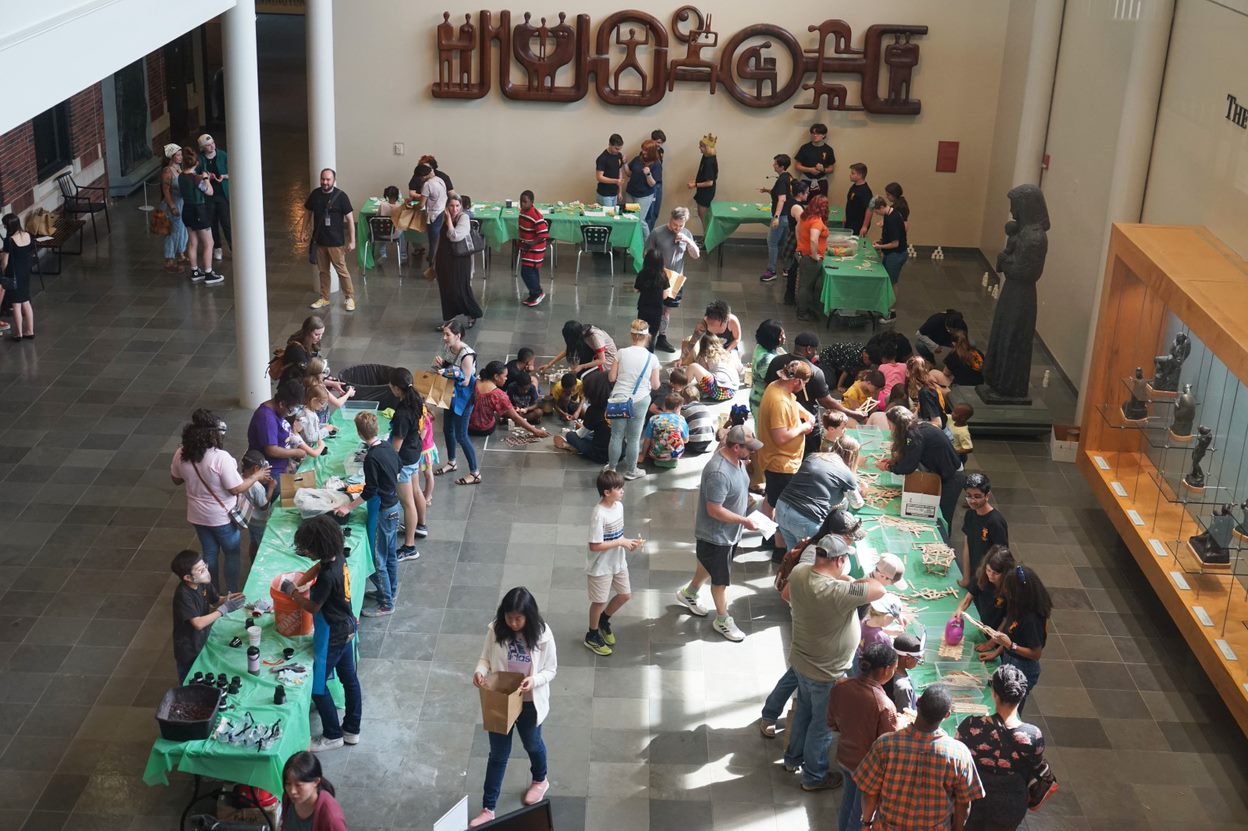
Nearly 50 students from my school, Glasgow Middle, and another local school, Baton Rouge Magnet High School, volunteered to run the stations. It was a joy to work with one high school student in particular, Marwan Mikdadi, whose passion for outreach and STEM is unmatched. With the pandemic still a force to be reckoned with, we didn't know what to expect, but when the doors to the museum opened, we were flooded with visitors. All told we ended up with 701 participants! The museum immediately asked us if we would repeat the event the following year.

Flash forward to this past spring, and we are now in the books with "All STEM Leads to Rome 2: Classical Chemistry and Engineering." We were sponsored by BASF, the international chemical company with a local plant in our city of Baton Rouge. Frequent sponsors of free Sundays and chemistry workshops for kids at the museum, they paid for the free admission for the "Free First Sunday" event (about $6000), and the Society for Classical Studies, another classics organization, paid for our activity supplies and t-shirts ($1000) with an Ancient Worlds, Modern Communities grant. With a nod to our sponsor, we focused on chemistry and engineering from the classical world.


Here's a breakdown of what we did:

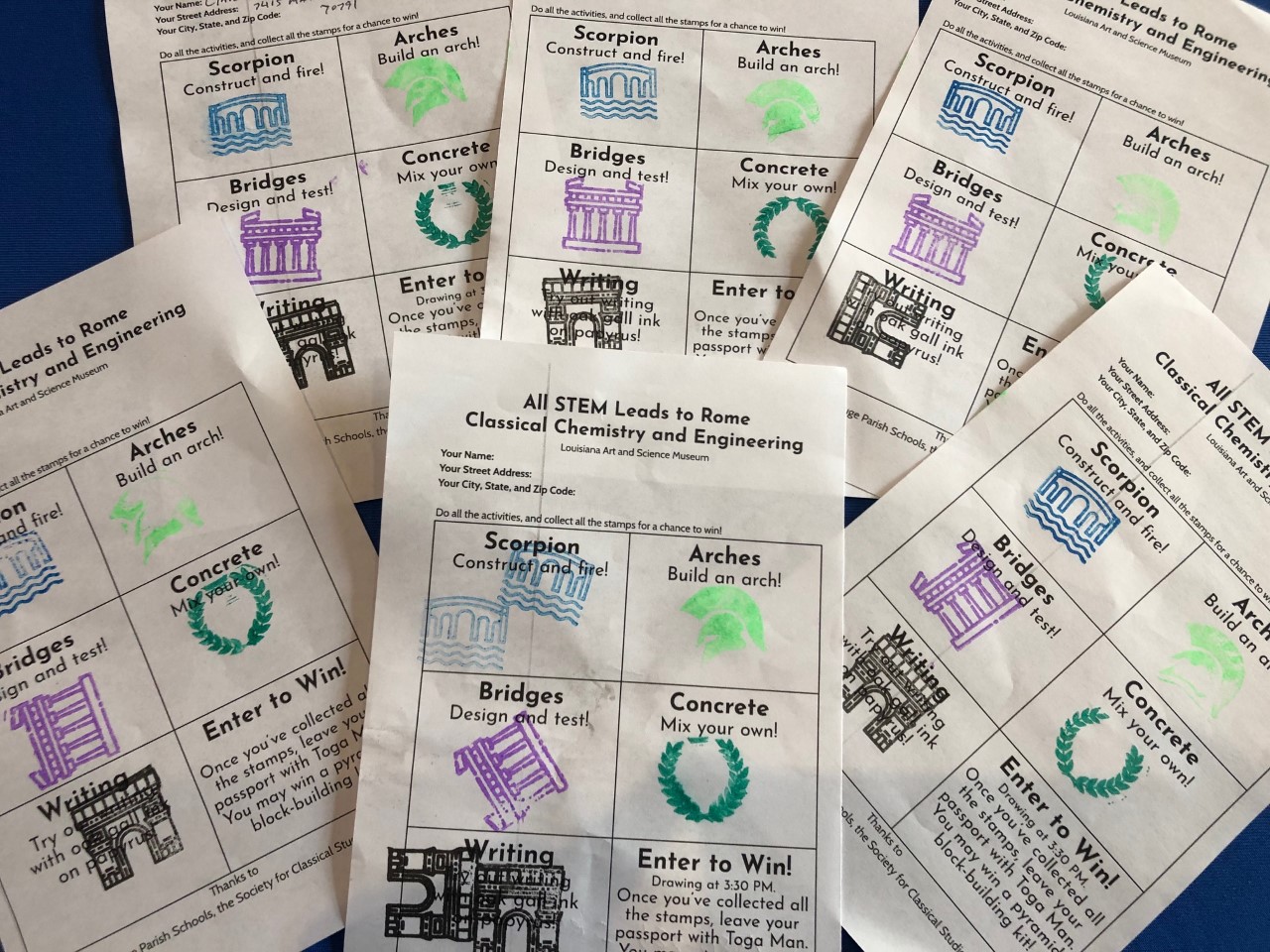
Greeting Station We had friendly students dressed up in Roman tunics and togas to welcome visitors and tell them how the event was set up. Each visitor received a "passport" with an explanation of each station to keep them on track. Those who returned the passport completely stamped were entered in a drawing to win a pyramid block building set.


In addition the the passport, visitors also received a small bag labeled with our Roman Technology logo to put collected items into.

Station 1: Mini Scorpions Visitors built this tiny scorpion out of large popsicle sticks, tape, and rubber bands. Then, they tried out their catapult model by firing cotton swabs at a small tower of cups.


Station 2: Arches Student leaders guided visitors in building a Roman arch with this building kit. We had taped off the floor in large squares so that block kits stayed in each square and didn't wander off to random spots on the floor.


Station 3: Bridges After contemplating what Julius Caesar's bridge over the Rhine may have looked like,  visitors attempted to recreate it using large popsicle sticks and rubber bands with a plastic container acting as the river. Once built, the strength of the bridges was tested by placing a 5-pount weight on it. You can see the anticipation in this young builder's eyes as her bridge is tested!


These next two stations focused on chemistry as a thanks to our sponsor, BASF.

Station 4: Concrete My students had just studied concrete in the context of their #RomanRoadProject so they were raring to teach this lesson to visitors. Each participant had to wear eye goggles to handle the lime mortar which added to the mystique of this station. Visitors were so excited to take home their very own container of Roman concrete.


Station 5: Oak Gall Ink Visitors learned how this ink was made from the tannin of oak galls made by tiny wasps, and then tried out writing ancient Roman cursive with that ink and a simple stylus on papryus paper. Last year, we used squid ink which was much smellier, but oak gall ink has its own iron scent too.


As I wander around during the event, I'm constantly stopped by adults who want to know who our students are and where their kids can go to learn this content. One of the best things about this event is that I do nothing during it except take pictures. Students handle all visitor questions and work with young children and adults to complete the activities.

This year, my students and I partnered with the Junior Classical League from the Louisiana School for Math, Science, and the Arts in Natchitoches, LA. After a brief online training with me getting them ready for the event, their wonderful Latin teacher, Dr. Morris Tichenor, drove them to the museum to spend the afternoon with us. They had clearly soaked up much of his knowledge of epigraphy. They were thrilled to be with us, and I hope this partnership lasts! In addition, we had a few stellar students from St. Joseph's Academy in Baton Rouge - they had assisted us with the #RomanRoadProject and were excited to join us.

Overall, we ended the day with almost 675 visitors, but to be fair, we were competing against the National Women's College Basketball Championship game. Baton Rouge's own LSU Tigers were competing so we think most people were understandably watching the game. Partnering with this local museum, allowing students to take the lead, has made for a wonderful annual classics in STEM outreach event. The museum has already asked us for All STEM Leads to Rome 3 for next spring, and we plan to be there! 

Weaving a New Version of the Odyssey

Have you seen Nolan's The Odyssey ? I got to see it on opening night in lil ole Galesburg, Illinois, at the end of a two-week K-12 Summe...